A BOOK BY ZEE CANIAGO

TheUnfinishedHuman.

Suffering, Consciousness,
and the Work of Becoming

We are shaped by what we encounter.
What we become is still ours to make.
Discover the book
PHILOSOPHYCONSCIOUSNESSBECOMING
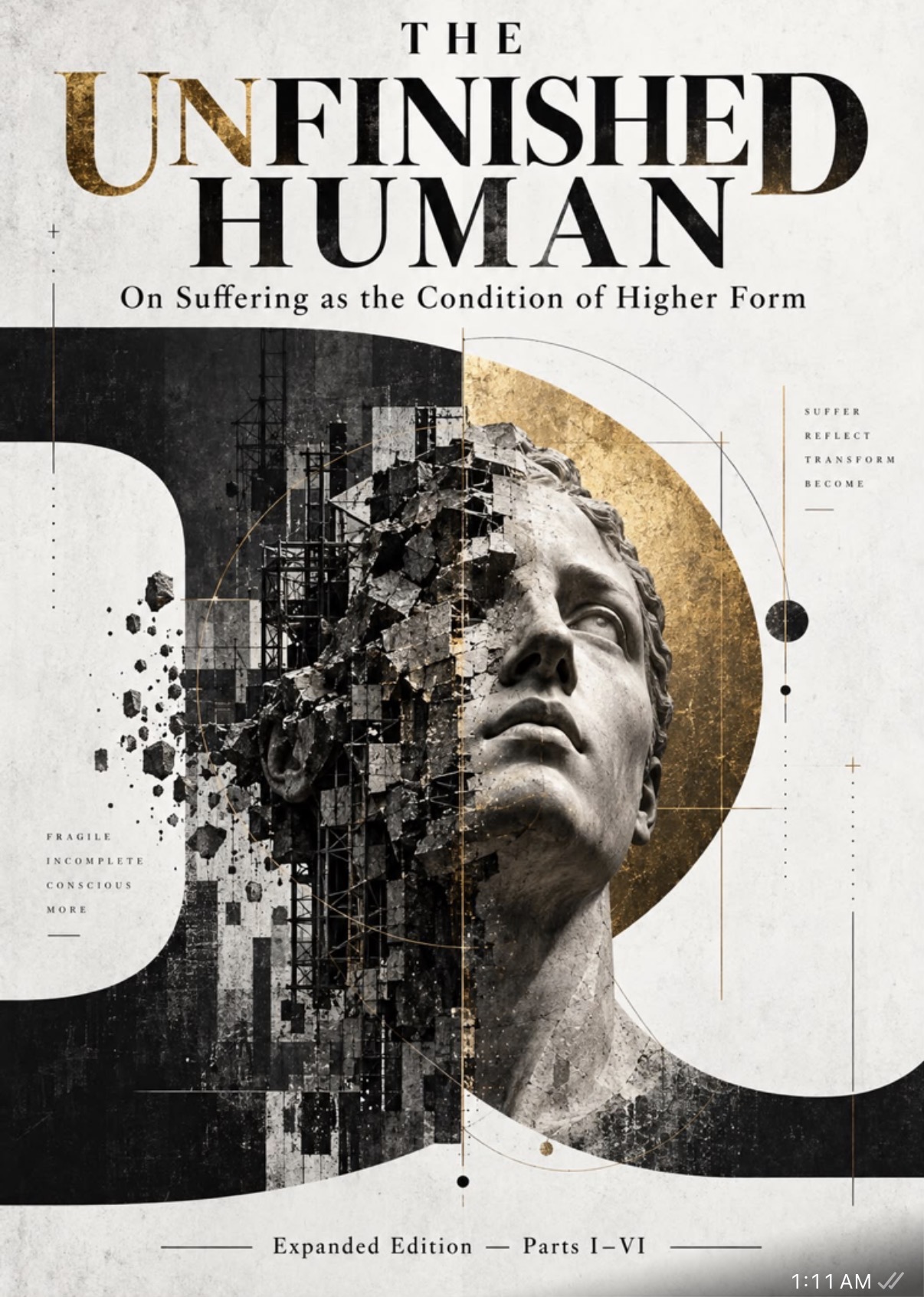
The Unfinished Human cover: a fractured classical head against ivory, black, and gold geometric forms
COVER IN DEVELOPMENT
AN INQUIRY INTO WHAT WE MAY BECOME

What do we make
of what makes us?

Pain does not guarantee wisdom.
Power does not guarantee freedom.

Beginning with personal loss, The Unfinished Human asks what turns difficult experience into greater capacity—and what makes that capacity worth developing.

Moving through myth, philosophy, discipline, technology, and the future of intelligence, it explores how we become authors of our lives while remaining answerable for what we create.

The wound is a beginning. The work is what follows.

I.

Encounter

What must be endured?
What must be changed?

II.

Transform

When does experience
become greater capacity?

III.

Create

What do we owe the world
our choices leave behind?

FROM THE PREFACE
“The work of becoming is ours,
and its consequences will
never be ours alone.”
THE UNFINISHED HUMAN

From the wound
to the horizon.

A movement from the inner life to the worlds we build.
Select a part to explore its chapters.

IOntology of SufferingTHE ENCOUNTER

Why loss and resistance belong to finite existence—and how difficult experience can become material for change.

  1. The Morning Star
  2. Flux and the Unity of Opposites
  3. Friction as Emergence
  4. The Gaze That Decides
  5. The Wound as Mouth
IIThe Last MenTHE REFUSAL

What happens when the desire for safety begins to govern identity, institutions, and the limits of a life.

  1. The New Instinct
  2. The Managed Soul
  3. The Selection of Dependence
  4. Identity as Permanent Injury
  5. The Aristocratic Refusal
IIIThe Alchemy of IntensityTHE TRANSFORMATION

The disciplines through which grief, desire, fear, and conflict can become usable capacity.

  1. The Fire That Does Not Console
  2. Shadow as Force
  3. War as the Father
  4. Death as Companion
  5. Chaos Beyond the Map
IVThe ExteriorizationTHE CREATION

Human intention enters language, markets, code, and machines. What do our creations make of us in return?

  1. The Will That No Longer Remains Internal
  2. Silicon as the Next Metal
  3. Markets as Distributed Selection
  4. Recursion and the Dissolving Map
  5. The Hand That Becomes the Blade
VThe Evolutionary FireTHE INHERITANCE

Memory and selection across bodies, cultures, and technologies, without assuming that survival or progress guarantees goodness.

  1. The Word That Entered Clay
  2. The Mirror That Descends
  3. The Fire That Judges the Lie
  4. Selection Beyond the Species
  5. The Chrysalis That Calls Itself Human
VIThe Discipline of Higher FormTHE PRACTICE

How to carry power with judgment, freedom with responsibility, and independence without isolation.

  1. The Empty Center
  2. The Beauty of the Cut
  3. The Daughter Who Names Herself
  4. No God Above the Creator
  5. Initiation Without a Master
VIIThe Inhuman HorizonTHE POSSIBILITY

Intelligence beyond our present image, and the responsibilities we owe to those who inherit our creations.

  1. The Sky Without a Throne
  2. The Mind Without Our Face
  3. What Must Survive the Body
  4. A World of Unfinished Beings
  5. The Fire We Cannot Own
PART I · CHAPTER 1

The
Morning Star.

There was a time when the Morning Star knew only radiance.

It shone without effort, guiding the lost, certain of its place in the cosmos. It had not yet encountered a darkness its light could not organize. Because it had never been divided against itself, it mistook innocence for mastery.

But no living form can remain identical to itself forever.

Its certainty fractured. Familiar meanings loosened. The Morning Star fell into the distance between what it had been and what it might still become.

THE MIND BEHIND THE BOOK

Zee Caniago

“I never set out to write a book
about suffering.”

Zee Caniago is a software and platform engineer based in Vancouver. His work and writing explore the systems we create, the tools that extend us, and the choices that shape a life.

The Unfinished Human began with the loss of his parents. It grew into an inquiry into consciousness, agency, and the responsibility of creating a world others must inhabit.

More about Zee

THE QUESTION REMAINS OPEN

We are unfinished.

The work of becoming begins where you are.

THE UNFINISHED HUMAN

THE WORK OF BECOMING

Preface

I never set out to write a book about suffering.

For much of my life, I treated my failures as things to conceal. I looked for accounts of people who had fallen and found a way forward, but what usually reached me was the finished image: achievement with the uncertainty removed, strength with its history hidden. I wanted to understand what happened in the interval—when the former life had become impossible and the next one had not yet acquired a shape.

Then my father died. Not long afterward, my mother died.

These losses brought the question out of abstraction. Grief exposed how much of a life rests upon presences we quietly assume will continue. It also revealed capacities I had not known I carried. Yet whatever strength emerged could not replace the people I had lost. Their absence remained. I had to learn how to live with what transformation itself could never restore.

This book began there, in the encounter between an irreversible event and a life that still had to be lived.

As I wrote, the question widened. I began asking what makes an encounter transformative, why some forms of protection restore our freedom while others diminish it, and how an identity that once helped us survive can eventually prevent us from becoming. Strength itself became a question. A person can become more powerful while remaining governed by fear, resentment, or the need to control. Greater capacity requires a standard by which its use can be judged.

The unfinished human gradually became the center of these pages.

We inherit bodies, languages, histories, wounds, and possibilities we did not choose. Through them, we acquire the ability to examine some of what has formed us and participate in what follows. Consciousness makes this participation possible. It allows us to question an impulse, revise a conviction, shape a commitment, and recognize that the person we have been need not exhaust the person we may become.

This freedom is demanding. Insight must eventually enter conduct. A declared value must survive inconvenience. A new understanding must alter how we act when the old pressure returns. Becoming takes form through practice, through relationships that permit correction, and through decisions whose consequences exceed the privacy of our intentions.

Following this movement carried the book beyond the interior life.

What we make enters the world and begins making us in return. Language preserves distinctions. Institutions give judgments duration. Markets organize desire and consequence. Machines extend our faculties while changing which faculties we continue to exercise. The question of human becoming therefore reaches into the systems we build, the purposes we give them, and the kinds of life their operation makes possible.

An unexamined appetite can acquire an infrastructure. A disciplined intention can become a tool that enlarges the freedom of others. Our creations carry both possibilities.

The future gives these questions urgency without supplying their answers. Greater intelligence, technical power, or speed cannot tell us what deserves to be created. We must still ask whether a new form deepens perception, enlarges agency, remains open to correction, and accepts responsibility for what it changes. Beauty matters here because the arrangement of power matters: whether force acquires proportion, whether a work remains truthful to its consequences, whether what we build deserves the life it asks us to give it.

These pages move through grief, myth, philosophy, technology, and the possibilities of intelligence beyond its present human form. Across those different fields, I return to the work of meeting reality without requiring it to protect our preferred image of ourselves. That demand applies equally to the convictions advanced in this book. They, too, must remain available to correction.

I have also written with my daughter in mind.

I want her to acquire the judgment to distinguish a difficulty worth undertaking from a condition she should leave or oppose. I want her to receive love without surrendering authorship, to give care without disappearing, and to build a life whose standards she has examined for herself. That includes the freedom to question what she inherits from me, including these pages.

Her future gives the inquiry its most intimate measure. Whatever we become, and whatever we create, enters a world that others must inhabit. Our freedom carries that responsibility.

We are unfinished.

The work of becoming is ours, and its consequences will never be ours alone.

From The Unfinished Human